Showing posts with label cocoa. Show all posts

Sunday, May 18, 2014

Take 2 (or is it 3?)

We are currently back in Makassar resting up at the Fave Hotel after another quick road trip taking in the usual destinations, where once again we stooped and stumbled our way through cocoa orchards, Sue diagnosing the leaves for disease (which she can now do in a matter of seconds) and me tapping the stats into our trusty iPad, which has made the whole process much more doable. (The thought of doing it all with pen and paper and transcribing it at the end of the day onto the laptop makes me shudder.)


Along the way we have covered many kilometres on the Trans-Sulawesii Highway and its offshoots, and made it as far north as the bottom end of Lake Poso in Central Sulawesi.

This time around we did not have the luxury of a 'company car', so did the first leg of the trip, from Makassar to the Mars research station in Tarengge, by overnight bus, choosing the optimistically named Kharisma bus lines. I was all set with my technology to help get me through the night, but found that the rental movie that had taken me days to download onto the iPad due to dodgy internet connections had already expired. The backup was the trusty old iPod mini with a load of songs on board — streaming's not something you can really count on here in Sulawesi.

All in all the 12 hour bus ride wasn't too bad, once we actually got going, but the bus was apt to stop at random points to pick up people, even within a few kilometres of the depot. Try doing that in Australia.

Seats on the Kharisma bus are business class!


Most towns of any size here in South Sulawesi have at least one statue of note. As you enter the town of Masamba, an hour before Tarengge, you are met with what looks like a tribute to the NRL but is actually acknowledgement of the region's main cash crop: cocoa ... the Big Pod as it would be called in Oz.


Tarengge's own statue has more of a general welcoming message for folks who are arriving ...


... but less so for those leaving town.


A huge advantage of the Tarengge site for us are the facilities and generous people of the Mars Cocoa Development Centre. This impressive research station has plantings of 45,000 cocoa trees all for research rather than commercial purposes. Here they monitor which are the best varieties in terms of yield and disease resistance, as well as a host of other factors such as plant management regimens and even planting distances.


They also have an air-conditioned office and a canteen where we have been fed and watered numerous times 'on the house'. They even delivered some morning tea and umbrellas to us in the field one morning as we copped a unusual shower of rain. Legends.


As well as studying some of the trees in the Mars plantation, we have also been monitoring another small planting about 2 km down the road in a little village called Cendana Hijau. We've now spent 4 or 5 afternoons in this plantation, and the nicest part is the walk back to Mars as the late afternoon cools off. The locals are mostly outside sitting around, the young ones circling on bikes, and the sight of a couple of bule (Westerners) walking (actually on foot!) seems to make their day.


Our travels have included most available modes of transport, except the horse and cart, which is still in use by the Mandar folks around Polewali. Sometimes the easiest and cheapest option is the pete-pete (petay-petay), tiny minibuses that travel mostly fixed routes but stop on demand, taking as many as they can cram in, the standard fee usually being around 0.30 cents.


There are many unnerving moments travelling on Sulawesi's chaotic roads, not the least of which are when streams of scooters and cars sail gaily through a red light. I asked Anwar, our driver, about this once, and in essence his reply was that: "conditions apply, read the small print", i.e. the little signs below the traffic lights. In this case, "Left turn must obey the light" ...


In this case, "Straight ahead can continue".


The red arrow would be a big breakthrough here, I'm thinking. Just one more reason why I'm happy to leave the driving to others.

Back in Makassar we are staying at the modern, comfortable and value-for-money Fave Hotel, well located in the Kawasan Kuliner (culinary district). It's only downside is that "fave" is not a natural homophone in Indonesian, so many taxi drivers will not understand it pronounced this way. Instead, you need to experiment with variations like "Farfay", "Parpay", "Parfay" etc. until you achieve recognition.

Over the road is one of the most popular eating spots for locals, Lae Lae.  The decor is no-frills but their house specialities of barbecued fish and other seafood are excellent.


We are also just 5 minutes walk from Pantai Losari (Losari Beach), Makassar's town square and civic heart. The kilometre-long waterfront promenade is populated at most times of the day and night. Sunset photographs against the giant place names are especially popular.


Yesterday a group called Forum Mahasiswa Pinggiran (Forum for Marginalised Students) held a Clean Up Losari Beach rally, venturing out in rubber duckies to scoop up some of the countless plastic bags, bottles and other rubbish that are the main downside of the waterfront. Rubbish is a problem all over Makassar, but it was great see a local group of students trying to do something about it.

Today, Sunday, was market day at Losari Beach and, from 7 a.m., time for the biggest community aerobics session you've ever seen. And yes, Sue and I did shake our booty for 10 minutes or so, until it all just got too sweaty. And that's without the jilbab. Enjoy!


Did you know?

The northern coast of Australia was once part of the Gowan empire. They don't teach you that at school.

Map in the Balla' Lompoa Museum (former residence of  Sultan Hasanuddin), just outside Makassar, showing the reach of the Gowa Empire in the 17th Century.

Rough translation: MAP: The Gowa Kingdom and regions that recognised his authority up to the year 1660-1659. The Sultan of Gowa  was recognised as the protector of Muslims in Maluku.
© 2014 Steve Dobney

Monday, April 14, 2014

On the road again

The last 3 weeks have seen the intrepid Sulawesi team embark on another whirlwind tour of the cocoa sites to complete round 1 of the data collection for the cocoa project. This visit has been sandwiched between two important family events requiring trips back to Melbourne: Miles turning 21 and Rosie moving out of home for her first proper job, in Sydney.

Here’s a map of where our travels have taken us since touching down again in Makassar at the end of March.


Wotu, in the northeast, is the closest place Google Maps will recognise to the village of Tarengge, where the Mars research plantation is located. On the northwest coast “Jalan Ahmad Yani” is actually the proper location of Majene, which Google places about 100 km further north. This problem stems from the fact that cities and towns often have the same names as the districts (kecamatan) they lie within. For Victorians, it's like having a town called Gippsland located in Gippsland. It’s something that has caused us a fair bit of confusion when we've asked our drivers "How far to X?", and they reply "Oh, we're already in X".
Returning to familiar places, reconnecting with familiar people, feeling my Indonesian coming more easily — all these things have helped to make this trip more relaxed, despite the business-like pace we have set. Sulawesi is feeling a lot more doable!

Thanks to the cocoa project, we had the services of their driver Anwar for the first part of the trip, so took the opportunity to do a little bit of sightseeing along the way. From Makassar we headed north via Bantimurung National Park, which is famous for a formidable waterfall, limestone caves and butterflies. British naturalist Alfred Wallace spent time in the area, apparently referring to it as “Kingdom of the butterflies”. Unfortunately, most of the beautifully coloured butterflies that you now see in the park are dead under glass, for sale to tourists. Apparently there is a breeding program to try to reintroduce some of the lost species.


On a brighter note, the river is a great place to cool down on a hot day. The day we visited there were lots of teenagers hanging out — young boys testing their bravado under the cascade, girls tubing in the quieter lower reaches — and families with young kids having picnics.


Downstream
Sue and young dudes testing their bravado at Bantimurung.


Here, as elsewhere, we are instant celebrities and pose for numerous photos. "Satu lagi!" ("One more!") is the usual request, as personnel and line-ups change. It's hard to believe that these young people could get any Facebook "likes" for posting photos with a couple of grey-haired Aussies, but who knows ...

We stopped overnight in Palopo, where we opted for the $17 a night Hotel Risma over the $45 a night Platinum. An interesting feature of the Risma is that the rooms have no windows to the outside; they all open off a central lounge, so the view is of other guests smoking. Also, like a couple of other ‘budget’ places we have stayed, the beds come with a fitted sheet and a blanket. Having been caught out before, we now carry our own top sheet which is usually all that’s needed.

In Tarengge we caught up with some of the Mars people we met on our February trip. Sue and I spend three days gathering data on the Mars trial plantation and a nearby farm, rain clouds helping to keep it cooler one day but the other days still ridiculously hot and humid by 11 am. Often we seem to be the only ones out in the sun (mad dogs and Australians …). 

There was a slightly sickening moment when we discovered that some of the special botanists’ tagging tape we had used to tag affected branches on the cocoa trees had been eaten by insects and was almost falling off, so we had to improvise backup tags to try to ensure there will still be something there when we come back in June!


Pod examination at Mars, Tarengge

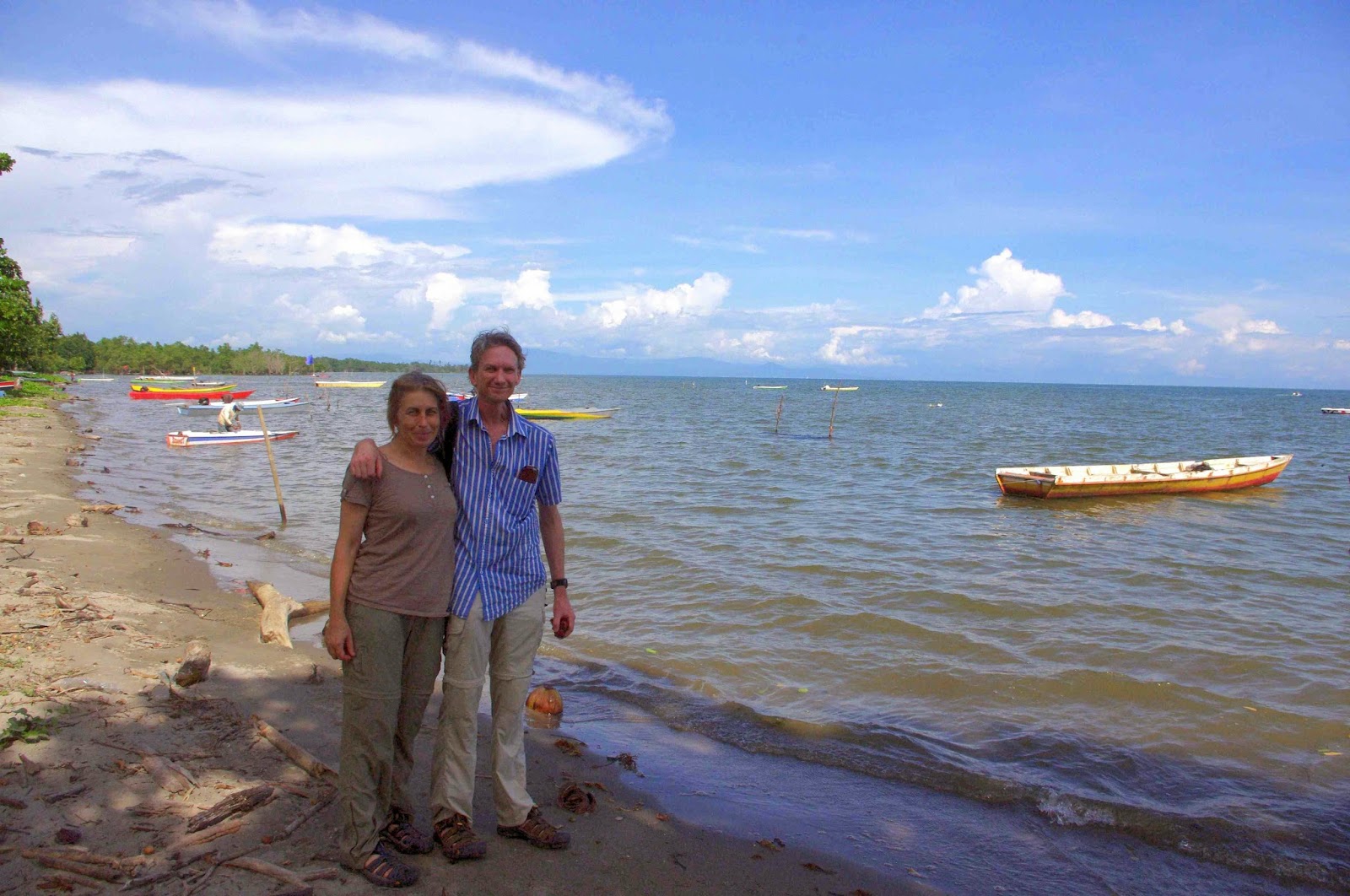
Leaving Tarengge we detoured off the main road to try to find the coastline. A few kilometres down the road we come to a small fishing village where a group of women are untangling seaweed from the nets used to harvest it, to be used to make agar agar they told us. We are at the top of the Bay of Bone, somewhere as far off my mental world map as I can imagine. The sand is black and the water is the temperature of a bath.


Standing on the top of the bay ... of Bone
Our next destination was Pinrang and Anwar told us the quickest route was via Rantepao in Tana Toraja, so once again we got a tantalising taste of Sulawesi’s most famous region in passing. This time we stopped for more than coffee, though. Anwar took us to the village of Ke’te Kesu’, which has become a tourist park, so I’m unsure whether people still live there or not. Regardless, there are a series of large impressive family tombs ... and more.
The village of Ke’te Kesu’
As we climbed the steps set into the face of the limestone cliff we passed cave tombs and disintegrating coffins spilling out crazy jumbles of bleached bones and skulls. Above our heads were other coffins held by beams set into the cliff face, in various states of dilapidation. Occasionally, skulls and bones must literally fall out of the sky.


Crumbling coffins, boxes of bones
For people who put such a high cultural emphasis on farewelling the dead in elaborate and expensive funeral ceremonies, Torajans seem to have a strange indifference for their remains beyond the grave. Obviously, there’s a lot more to be learnt about this, and I’m looking forward to spending some time doing that and trekking in these mountains later in the year.

In Pinrang we once again stayed at the crazily Bollywood-style Permata Hotel. Anwar left us there to head back to Makassar, but by now we were starting to get the hang of arranging transport in Sulawesi: basically, stand around by the side of the road and you'll be offered a ride. In this case, the hotel owner made a phone call that provided us with two guys who became our ojeks (motorbike taxis) for the next few days. They in turn knew another guy with a car who provided the transport for the next leg — back to Polewali.


The over-the-top Permata Hotel in Pinrang. BYO sheet and sunglasses.


Having written before about the joys and sorrows of Polewali (see Postcards from Polewali #1 and 2), I won’t go into too much detail this time, except to say:
  • Yes, we stayed at the Ratih Hotel again. The idea of staying out in the village of Beluak is still attractive, but we were working to a tight schedule and the lure of air-con, a pool and wi-fi was too strong. [Does that sound weak and pathetic?]
  • Village life did seem as charming as ever. We spent a very pleasant couple of days traipsing around Pak Syukur’s cocoa farm — essentially his backyard — drinking coffee with him and his wife, and being dinked to and from town by his sons Aswal and Iqbal.

With one more cocoa location to visit, about 30 km further up the highway at Sumarrang, we decided to shift our base from Polewali (not surprised?) and push on to Majene, which would be new territory for us, with only a 25 km trip back to Sumarang. We had heard good things about Majene, including the tantalising fact that there is a beach with white sand. It turned out to be a great decision (stay tuned for "Postcard from Majene").

Words of the week

Indonesians love a good acronym. Here are a few local ones:
Tator: Tana Toraja
Sulsel: Sulawesi Selatan (South Sulawesi)
Sulbar: Sulawesi Barat (West Sulawesi)
Sulselbar: I'm sure you can guess that one
Calpres: Calon presiden (presidential candidate)

Links

Bantimurung National Park


Ke’te Kesu’, Tana Toraja

Sue's blog

http://3-degrees-south.blogspot.com

© 2014 Steve Dobney

Sunday, April 13, 2014

Finding Sugar Man in Anreapi

During our 3 days in Polewali we visited the desa (village) of Beluak in the Anreapi district a couple of times. It's about 10 k out of town towards the surrounding hills.


The village itself is very pretty, with traditional South Sulawesi houses (raised up on poles) lining both sides of the street. At the home of the head farmer, Pak Arifin, the kids were busy painting a length of low bamboo fencing in blue and white paint. Looking around, most of the other houses nearby were sporting freshly painted front fences, all blue and white, about half a metre high, and people were generally busy making their street frontages look pretty. We asked about the reason for all the activity, and it turns out there was the local equivalent of a Tidy Town competition coming up, and the residents of Beluak were keen to take out the trophy. 

Beluak main street

In front of Pak Sakur's house was a traditional raised platform (balai balai) with a roof, which is a great place to hang out and watch the passing action (perhaps a stray goat) and catch a cooling breeze. On our first visit, after examining the the trees in a nearby trial planting, I was hanging out on the platform, cooling down and chatting with the young Indonesian drivers. I tried to explain where we were from and what the hell we were doing there. I mentioned our kids and the question of my age came up. Berapa umur Pak? When I replied that I was 54, the two drivers shot each other the kind of look that suggested one of them had just lost a bet. I asked them how old they thought I was. Saya pikir tujuh puluh tujuh, replied the driver. Seventy-seven. God knows I haven't aged well, but that was a blow. I laughed it off as best I could, decided not to tip the driver, and made a mental note to investigate laser dermabrasion options back in Melbourne.

On our return a few days later we visited the cocoa plantation of Pak Arafin, which starts just behind the houses and stretches on up a hillside. Not far along this track we came across the guys harvesting rambutan (see the photo in last week's blog) and got to sample the fruit. [Having since tried durian a couple of times, rambutan is definitely my favourite. Rambutan tastes like banana and garlic custard, but is widely popular, particulary with the blokes. Perhaps it's a sign of gengsi (prestige).]


Rambutan stop

After checking the cocoa growing at the lower levels, our expedition leader Pak Philip asked Pak Arafin to take us further up the track, to see where the cocoa ended and the rainforest began. We climbed for more than an hour through a beautiful landscape of cocoa interwoven with taller trees – coconuts and wild mango (alas, no ripe fruit) – and sweated a bucketload in the process, but the forest edge was still a long way off. We stopped for a breather and to admire the view: in one direction, rice fields stretching towards the coast at Polewali; in the other, cocoa and coconut trees spreading across the hillsides as far as we could see. 


From there on the track became a narrow path traversing the slope. Pak Arifin was leaping ahead effortlessly but I for one was staring to get a tad grumpy and was just asking him as politely as I could “Berapa jauh lagi, Pak?” (“How much further, man?”) when we stumbled round a bend to find a little shack with smoke coming from the roof. 


Inside the gloom was a bare-chested middle-aged man in a sarong, two tiny kittens, and a large wok of yellow liquid gently plopping over a fire. It was surreal, like stumbling across a hermit in his cave. The stuff in the wok turned out to be palm sugar, being reduced to solid form, and sugar man promptly offered us a cup of the work in progress, which was, well ... very sweet. 


Pak Arifin, Peter and the sugar
Sweeeeeeeet!

After a bit of idle chat, we made moves to go, but as we clambered out of the hut one of the corner posts gave way. Sugar man toppled to the ground, was knocked on the head by the falling piece of wood and did a backwards roll down the hill. Needless to say we were all very concerned, but after taking a minute to get his bearings, sugar man assured us he was fine, so we left him with his kittens and started the trip back down. Nearing home, Pak Arifin stripped off his shirt and climbed straight up a 30-foot coconut tree with his machete, which he expertly employed to cut down 4 coconuts. 

About 10 minutes later we were sitting around out the front of his house, recovering with a coconut juice. “So does the sugar man live up there all the time?” we asked Pak Arifin. “No,” he replied, “he lives in that house across the road. He just goes up there every so often for a few days to make some sugar. In fact, he’s over there, at the house next door right now.” Sure enough, there was sugar man, clean shirt and neatly combed hair, chatting with the neighbours like a regular guy.


Fact of the day

Sulawesi was the source of a hair oil that was used by gentlemen in the old days in Europe. To avoid having their good furniture greased up, ladies would place strips of fabric over the backs of their chairs and couches. These pieces of fabric were known as antimacassars.

© 2014 Steve Dobney

Wednesday, March 12, 2014

Postcard from Polewali 2

The title of my earlier post, "Postcard from Polewali" turns out to be ironic. I spent some time today walking the streets trying various shops and the post office, but it turns out that the town of Polewali does not consider itself worthy of producing such a thing as a simple postcard. People were familiar with the concept – kartu pos –– but couldn't recall actually seeing them for sale anywhere. The guy in the post office was willing to estimate the postage, should I be able to find one, and sell me the necessary stamps, but I have a feeling those stamps will remain unused. It shouldn't come as a surprise, I guess. As you can see from my snaps below, Polewali is not a pretty town and it doesn't attract the kind of people who might want to send postcards, i.e. tourists. 


The mean streets of Polewali


The Hotel Ratih and its less salubrious neighbour

In our week staying here, we haven't seen any other Westerners, and we invariably create a minor commotion walking down the street, just by being different (even when I'm wearing my batik shirt).

Usually it's just the standard "Hello mister, hello missus", but variants include horn honking, dangerous turning of heads while riding of motor scooters, occasional pointing (as if to say "Hey white people, look at the funny white people"), and clustering of amazed, hysterically laughing schoolkids. It is always good-natured, often involves a photograph, and sometimes develops into an actual conversation if either party has the time and language.

The other thing that makes us oddities is possibly that we are walking. You certainly don't catch many locals doing it, and we are constantly being offered more acceptable options, such as becaks and pete-pete (micro vans with bench seats, standard fare 0.30 cents). It's not hard to see why. There are no footpaths, just a choice between the general roadside rubble and the drainage ditch, which is sometimes covered but mostly open. Cars park wherever they want on the road edge, which means you often have to dodge out into the traffic lane where becaks and scooters weave between trucks and the occasional car, all with plenty of horn honking but precious few actual collisions [touches wooden object, makes sign of cross].


The streetscape along the main street consists mainly of dark, dingy, broken facades hosting every kind of business from restaurants and warkops (warung kopi = coffeeshops) to motorbike repair shops and a surprising number of photocopy services. Interspersed are precincts for schools and the library, which are a little grander, and the stark contrast of a spotless and brightly lit Alfamart store.

Oddly, the town is spread over a few kilometres, with a stretch of rice paddies in the middle, maybe on lower lying land, which provides some visual relief but adds to the travelling. We are staying the newly completed and certainly grand (but unfortunately named) Hotel Ratih, but the block next door looks like a bomb zone in Baghdad. In short, Polewali is a hard town. 

Having said that, we have eaten well here. The regional specialty is ikan bakar (barbecued fish), cooked on an open grill out the front of the shop. Before you enter you choose your fish from the selection on ice in a polystyrene esky, It's basted in some kind of delicious garlicky spicy paste and goes down well with some cap cai (mixed vegetables, but the local variant must include some prawns), nasi putih and an es jeruk or jus melon (iced orange juice or melon juice). The heat conjures up dreams of ice cold beer, but that is only available in the swankier hotels (like the Ratih) and even then you need to give the staff notice to put it in the fridge.


Ikan bakar

The ubiquitous kecap manis: "NEW: Blacker, more deliciously salty and oily, thicker".  
Polewali improves, though, as soon as you get a block or two from the main street, where the newer houses and ruko are going up amid the rice fields, and within a kilometre or two you are in another world of the desa (village) and dusun (whatever is smaller than a village!). This is where Sue and I have been spending most of our mornings up until 1 or 2 pm, primarily examining the cocoa trees belonging to a couple of local farmers, but also getting a little glimpse of village life. 

Sue relaxing on the balai balai with tools of the trade
Each morning at 8 we are called for by a couple of guys on motor scooters who dink us (a mode of transport called ojek) the 5 or 6 kilometres through the rice paddies to the village of Beluak. It's an absolute mood-changer, a great way to start the day, despite the occasional white man's worries about accidents, travel insurance and whether the rate of $2 one way that we are paying them will distort the local economy, since the recommended rate was only $1.


Pak Syukur's house with the balai balai and table tennis table in the "carport".


The village of Beluak, Anreapi

Pak Arafin and family, and a crop of coconuts
Our first day on our own in the cocoa field looked like being a fizzer when the reality of the trees didn't match Sue's plans, but our host Pak Arafin was more concerned that we should attend the ceremony taking place in the village's open air mosque (no domes, no minarets). We were ushered in, shoeless, and with a bit of shuffling seated on the floor in the loosely segregated groups, me with the men, Sue with the women and children. There was a sermon from a young and friendly looking vicar (imam?) that I didn't understand, but which got a few laughs, and a central arrangement of a banana tree hung with little baskets containing boiled eggs. It all reminded me of Easter. 

It turns out that it was Maulid,the celebration of Muhammad's birth, celebrated in some Muslim countries but frowned upon in others; hence my sense of it being about new life was not far off. After the formal part of the service the women whipped out plates food they had prepared and after a lot of deferring to each other we all tucked in. It was all incredibly friendly and relaxed. Yes, there were some jilbab (headscarves), but there were bareheaded women as well and none of that seemed to matter. Despite our obvious status as non-believers, we were given the gifts of the small egg trees to take away at the end of the ceremony. 


Pak Arafin and family with the egg trees
Another day, after 4 hours work in the increasing heat, we are walking back to Pak Arafin's place and notice a couple of houses with goods for sale in the front window, which is common in the villages. "Ada minuman es?" (Do you have ice drinks?) I ask hopefully. "Ada", is the correct reply. We happily sit on the plastic chairs while the ibu of the house/warung mixes ice from an esky, a bit of water and our choice of flavour sachet in a blender and a minute later we are revelling in a couple of slurpies as feeling the core temperature drop back to normal. To the point where we follow up with a bowl of instant noodles; a simple but incredibly reviving snack. As we pay and leave, ibu is serving her next customer who is buying one of the bottles of petrol she has lined up on a rack, to top up his van. 

The ice and petrol lady

On Saturday as we had finished up our work in Pak Syukur's plantation, it seemed the  whole village was kicking back. The young boys were playing table tennis under a kind of carport strung with election banners to stop the ball going too far. The older boys were dozing on the raised balai balai (deckhouse) with their music player pumping out "Hotel California" and "Total Eclipse of the Heart" at a not unneighbourly volume, while somewhere across the fields some other 80s rock was answering the call. The girls, however, may well have been doing some housework inside.

Village life seems to occur in a loose kind of privacy; washing, snoozing, coming and going all go on in the public space and there is a lot of what seems like just sitting around. The schoolgirls wear headscarves, but outside of school they seem much less common, here at least. Slowly we have forged some relationships here in Beluak and I'm hoping that when we return in April we will take up Pak Arafin's offer of accommodation at his house. If we can turn our backs on air-con, beer and a swimming pool for a week or two.


Hard to resist: Hotel Ratih

Did I mention that we also went in search of a waterfall advertised on the internet, but deceptively difficult to find. To make things more interesting, we (OK, I) had chartered this most inappropriate vehicle for mountain climbing on rough roads: the urban pete-pete. But our fearless driver Hendra persevered and joined us on the 1 hour climb. More pics to come.
© 2014 Steve Dobney