Showing posts with label pete-pete. Show all posts

Sunday, November 2, 2014

Pantai Losari and the pete-petes

Well, here we are, 3 days out from packing our bags and heading back to Melbourne. After nearly 9 months the Sulawesi project is drawing to a close. So just time for one last post. Packing our bags will actually be some feat, because we've accumulated a lot of stuff in our time here, including a computer monitor and keyboard we brought over last time! See if we can get that into the hand luggage.

Apart from our trip to Kalimantan to see the orangutans and back to Australia to see our closer relations, we've been happily ensconced here in room 1119 at the Fave Hotel, subjected to nightly sunsets over the Makassar Strait through our massive picture windows. Hard life, but someone’s got to keep the hotel industry afloat. Photos don’t do it justice, but here’s one anyway.
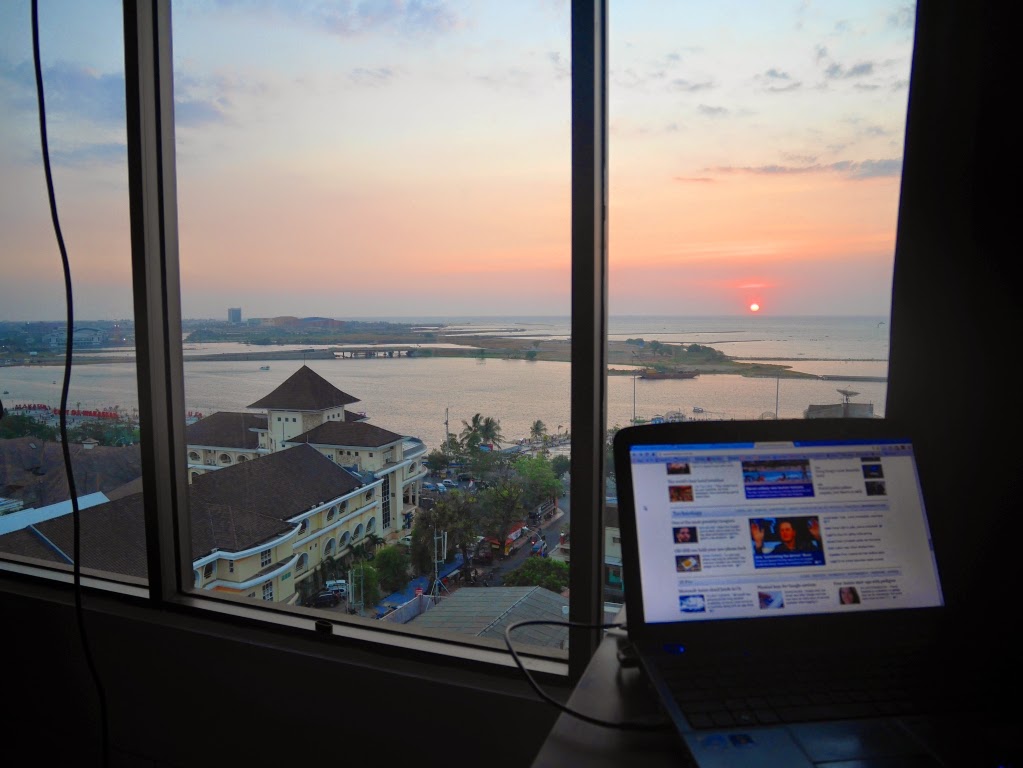

Tough gig, I know.
In fact, we've been lucky (or profligate) enough to have two connected rooms, so as well as the bedroom with the panorama we also have a kitchen/living area with a sink and microwave, which we've used to keep up a steady supply of 2-minute noodles with veggies and tofu – a semblance of normal life. It also means we can have separate desks that are more than a metre apart: Sue to carry on her arcane statistical jiggery pokery with the data we collected during our first 4 months, and me to ... what is it exactly I've been doing?

Well, I have started jogging again, along with the rest of Makassar, at Karebosi sportsground. You have to go before 7 a.m. or it's too hot.


"Jogging" here means walking in sportswear. You'll be pleased to know I have been doing it properly.
I've also been doing some volunteer English teaching at a nearby private English language school, ELC Education, usually one 1.5 hour class a day. It’s about 500 metres from the hotel but I do like cycling, so ... I take a becak. 


Another tough gig ... for the other guy.

Somehow in the 6 weeks or so that I've taken classes there, I haven't taught the same class twice. I estimate I've seen around 300 different students. The final class was a group of about 20 Papuan students who have scholarships to go to university in the USA starting next year. They are here in Makassar to hone their English skills before they sit a final IELTs test that will determine if they can go. They are a wonderfully positive bunch of youngsters.

My finishing up at the school coincided with their arrival in Makassar, so a combined welcome/farewell party was held last Friday at which I was presented with a trophy and a huge tiramisu cake, and the Papuan students performed a couple of songs with great gusto.


Steve's abridged history of Australia, including diagram showing early seafaring contact between Buginese sailors and Top End Aborigines, plus boomerang-throwing technique.
The Papuan students

When I look back at my first blog post from February, I was joking about putting the mysterious town of Polewali 'on the map'. As it turns out, I don’t expect Polewali will experience a huge upswing in tourism due to my blog posts, which were more a 'warts and all' kind of expose. What I have turned my attention to is putting Makassar on the map; or more correctly, putting the map on Makassar.

Living in Melbourne you get the sense that whatever you want to know about the place – which restaurants are hot, what’s on at the rooftop cinema, how to get from Footscray to Doncaster by bus – it’s all just a Google search away. You can be confident the information's out there somewhere, probably in an interactive user-friendly format. It’s been interesting to be somewhere where that isn't the case. Makassar doesn't exist in cyberspace, except in random bits and pieces.

One of the first ways I bumped up against this was when I started using the tiny micro-buses called pete-pete that are Makassar’s only form of public transport. The vehicles themselves are Suzuki "Carry" vans fitted out with rudimentary bench seats for up to 10 passengers, plus the seat next to the driver. Many of them are seriously beaten up but any discomfort is usually offset by a sound system with sub-woofers playing dangdut.


The humble pete-pete (route E: Makassar Mall to Panakkukang)

The not-so-humble sound system
You see them darting around everywhere, and they have route numbers and destinations printed on their windscreens, but being a Western rationalist kind of person, I wanted a map so I could see all the routes. Not an unreasonable expectation you might think. But after asking at town hall, and being sent on a bit of a wild goose chase, it became evident that there weren't any maps. Who would need maps? The locals all know where they go.

That turned out to be the thrown-down gauntlet I needed. 

I spent the next couple of weeks travelling the pete-petes, tracking the routes on my phone, comparing them with some lists I had managed to find on a blog site, then combining it all into some new Google’s maps. I got to about 10 and figured I’d probably covered most of the main routes that other tourists would want to travel.

Here's one I prepared earlier. You click the little white box to see the routes.


Getting a bit carried away with the whole mapping thing, I created another one showing all the places we've eaten, shopped, visited, etc. The kind of information we've found out by being here and being shown around by locals and expats, and that other travellers might find useful too.

Great, so I now had a bunch of maps. But to be of any use to anyone, they needed to be findable, and to be findable they really needed to be part of a website, and to be part of a website, I would need to ... make a website. Which was how I ended up on Weebly, a kind of "Make Your Own Instant Website for Dummies". About 3 weeks later, it's just about done. (Heck, I needed a project to keep me busy.) It still has a few gaps to be filled, and I'm sure you'll spot typos on the first page, but here in all its glory is [drum roll, please] ...


(aka The Other Sulawesi Project)


So tell all your friends, click on it a lot and help me push it up the Google charts to fame and fortune.

OK, so that's done.

This week we're also saying goodbye to the small group of people we know here in Makassar. One of them is a young man called Azimi, who we met maybe 2 months ago on one of our nightly walks at Pantai Losari. Azimi is a young Hazara man from Afghanistan who has worked, indirectly, for the international forces there. Those two things make him a target for retribution by the Taliban, which is why he left Afghanistan and made his way here. He has been in Indonesia for a year now and is still waiting for his case to be assessed by the UN to determine whether he is a genuine refugee. He's quietly confident that will occur, and also that his chances of being accepted into Australia are fairly good. But he may have to be here for another 12 months or more, waiting.

I can't help but be struck by the difference between his treatment here and the treatment of asylum seekers who made their way to Australia. Here Azimi is living in a basic hotel along with a group of other Afghani men, supported by the International Office for Migration. He's not able to work but he is able to move around freely in the community. He's not vilified by the locals, in fact he has made some Indonesian friends and is learning the language, as well as running English lessons for his compatriots. He is not locked up like a criminal. And this is in a country that is still struggling to lift 28 million of its own people out of poverty. Meanwhile asylum seekers in Australia are suffering extreme hardship with no prospects of resettlement.

Over the past couple of months, Azimi and I have had lots of walks around Makassar and adventures trying to find our way by pete-pete. I really hope I can take a Melbourne tram ride with him sometime soon.


Me and Azimi, out on a pete-pete adventure. We didn't plan the matching shirts, honest.

And that's just about a wrap. It's been a crazy 9 months, a jump into the unknown. We've seen a lot of South Sulawesi and a lot of cocoa trees and just when that started to wear thin we stayed put in Makassar long enough for me to rediscover my inner editor and try to bring order to chaos. So, if your partner comes home one night and says they've taken on a project in some place you've never heard of ... I say go for it. If they don't, suggest a trip to Polewali anyway. Maybe you can put it on the map!

Am I sad to be leaving? Yes, I am. Despite the heat and the noise and the lack of footpaths and our slightly surreal hotel-based daily life, I must have put a few roots down into Makassan soil and I will feel the wrench as our plane takes off on Thursday evening. I'll miss the people we've shared our time here with, and the smiling "Selamat pagi"s as I step out of the lift each morning.
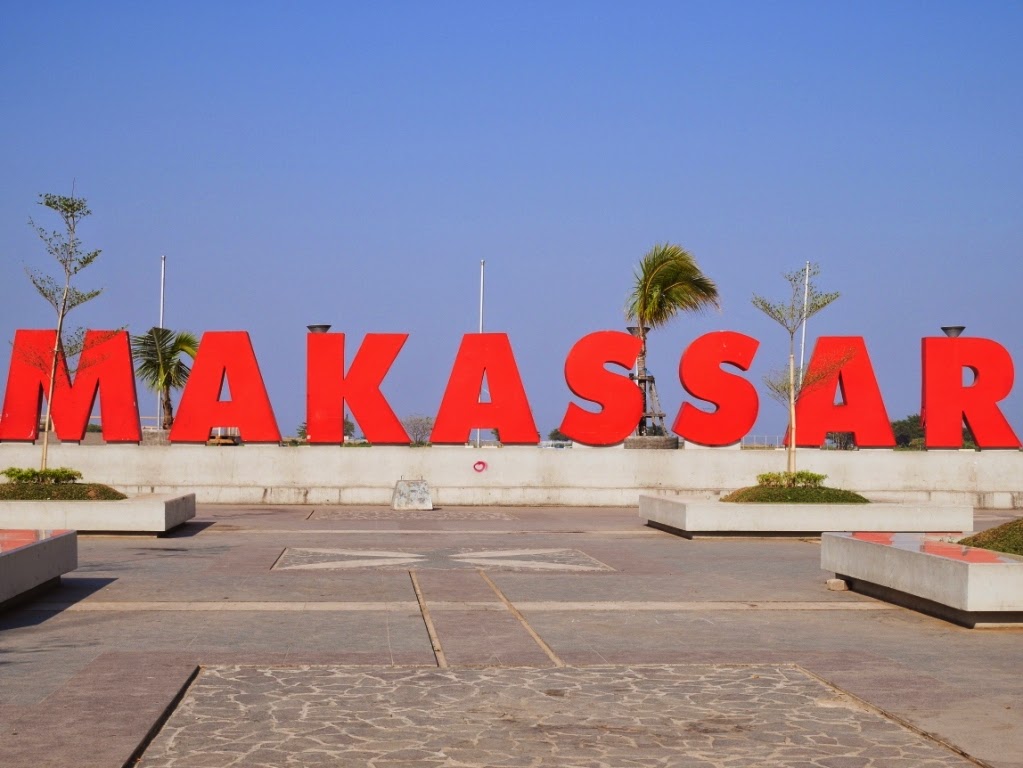


Bye Makassar, South Sulawesi. Sampai jumpa lagi!

Wednesday, March 12, 2014

Postcard from Polewali 2

The title of my earlier post, "Postcard from Polewali" turns out to be ironic. I spent some time today walking the streets trying various shops and the post office, but it turns out that the town of Polewali does not consider itself worthy of producing such a thing as a simple postcard. People were familiar with the concept – kartu pos –– but couldn't recall actually seeing them for sale anywhere. The guy in the post office was willing to estimate the postage, should I be able to find one, and sell me the necessary stamps, but I have a feeling those stamps will remain unused. It shouldn't come as a surprise, I guess. As you can see from my snaps below, Polewali is not a pretty town and it doesn't attract the kind of people who might want to send postcards, i.e. tourists. 


The mean streets of Polewali


The Hotel Ratih and its less salubrious neighbour

In our week staying here, we haven't seen any other Westerners, and we invariably create a minor commotion walking down the street, just by being different (even when I'm wearing my batik shirt).

Usually it's just the standard "Hello mister, hello missus", but variants include horn honking, dangerous turning of heads while riding of motor scooters, occasional pointing (as if to say "Hey white people, look at the funny white people"), and clustering of amazed, hysterically laughing schoolkids. It is always good-natured, often involves a photograph, and sometimes develops into an actual conversation if either party has the time and language.

The other thing that makes us oddities is possibly that we are walking. You certainly don't catch many locals doing it, and we are constantly being offered more acceptable options, such as becaks and pete-pete (micro vans with bench seats, standard fare 0.30 cents). It's not hard to see why. There are no footpaths, just a choice between the general roadside rubble and the drainage ditch, which is sometimes covered but mostly open. Cars park wherever they want on the road edge, which means you often have to dodge out into the traffic lane where becaks and scooters weave between trucks and the occasional car, all with plenty of horn honking but precious few actual collisions [touches wooden object, makes sign of cross].


The streetscape along the main street consists mainly of dark, dingy, broken facades hosting every kind of business from restaurants and warkops (warung kopi = coffeeshops) to motorbike repair shops and a surprising number of photocopy services. Interspersed are precincts for schools and the library, which are a little grander, and the stark contrast of a spotless and brightly lit Alfamart store.

Oddly, the town is spread over a few kilometres, with a stretch of rice paddies in the middle, maybe on lower lying land, which provides some visual relief but adds to the travelling. We are staying the newly completed and certainly grand (but unfortunately named) Hotel Ratih, but the block next door looks like a bomb zone in Baghdad. In short, Polewali is a hard town. 

Having said that, we have eaten well here. The regional specialty is ikan bakar (barbecued fish), cooked on an open grill out the front of the shop. Before you enter you choose your fish from the selection on ice in a polystyrene esky, It's basted in some kind of delicious garlicky spicy paste and goes down well with some cap cai (mixed vegetables, but the local variant must include some prawns), nasi putih and an es jeruk or jus melon (iced orange juice or melon juice). The heat conjures up dreams of ice cold beer, but that is only available in the swankier hotels (like the Ratih) and even then you need to give the staff notice to put it in the fridge.


Ikan bakar

The ubiquitous kecap manis: "NEW: Blacker, more deliciously salty and oily, thicker".  
Polewali improves, though, as soon as you get a block or two from the main street, where the newer houses and ruko are going up amid the rice fields, and within a kilometre or two you are in another world of the desa (village) and dusun (whatever is smaller than a village!). This is where Sue and I have been spending most of our mornings up until 1 or 2 pm, primarily examining the cocoa trees belonging to a couple of local farmers, but also getting a little glimpse of village life. 

Sue relaxing on the balai balai with tools of the trade
Each morning at 8 we are called for by a couple of guys on motor scooters who dink us (a mode of transport called ojek) the 5 or 6 kilometres through the rice paddies to the village of Beluak. It's an absolute mood-changer, a great way to start the day, despite the occasional white man's worries about accidents, travel insurance and whether the rate of $2 one way that we are paying them will distort the local economy, since the recommended rate was only $1.


Pak Syukur's house with the balai balai and table tennis table in the "carport".


The village of Beluak, Anreapi

Pak Arafin and family, and a crop of coconuts
Our first day on our own in the cocoa field looked like being a fizzer when the reality of the trees didn't match Sue's plans, but our host Pak Arafin was more concerned that we should attend the ceremony taking place in the village's open air mosque (no domes, no minarets). We were ushered in, shoeless, and with a bit of shuffling seated on the floor in the loosely segregated groups, me with the men, Sue with the women and children. There was a sermon from a young and friendly looking vicar (imam?) that I didn't understand, but which got a few laughs, and a central arrangement of a banana tree hung with little baskets containing boiled eggs. It all reminded me of Easter. 

It turns out that it was Maulid,the celebration of Muhammad's birth, celebrated in some Muslim countries but frowned upon in others; hence my sense of it being about new life was not far off. After the formal part of the service the women whipped out plates food they had prepared and after a lot of deferring to each other we all tucked in. It was all incredibly friendly and relaxed. Yes, there were some jilbab (headscarves), but there were bareheaded women as well and none of that seemed to matter. Despite our obvious status as non-believers, we were given the gifts of the small egg trees to take away at the end of the ceremony. 


Pak Arafin and family with the egg trees
Another day, after 4 hours work in the increasing heat, we are walking back to Pak Arafin's place and notice a couple of houses with goods for sale in the front window, which is common in the villages. "Ada minuman es?" (Do you have ice drinks?) I ask hopefully. "Ada", is the correct reply. We happily sit on the plastic chairs while the ibu of the house/warung mixes ice from an esky, a bit of water and our choice of flavour sachet in a blender and a minute later we are revelling in a couple of slurpies as feeling the core temperature drop back to normal. To the point where we follow up with a bowl of instant noodles; a simple but incredibly reviving snack. As we pay and leave, ibu is serving her next customer who is buying one of the bottles of petrol she has lined up on a rack, to top up his van. 

The ice and petrol lady

On Saturday as we had finished up our work in Pak Syukur's plantation, it seemed the  whole village was kicking back. The young boys were playing table tennis under a kind of carport strung with election banners to stop the ball going too far. The older boys were dozing on the raised balai balai (deckhouse) with their music player pumping out "Hotel California" and "Total Eclipse of the Heart" at a not unneighbourly volume, while somewhere across the fields some other 80s rock was answering the call. The girls, however, may well have been doing some housework inside.

Village life seems to occur in a loose kind of privacy; washing, snoozing, coming and going all go on in the public space and there is a lot of what seems like just sitting around. The schoolgirls wear headscarves, but outside of school they seem much less common, here at least. Slowly we have forged some relationships here in Beluak and I'm hoping that when we return in April we will take up Pak Arafin's offer of accommodation at his house. If we can turn our backs on air-con, beer and a swimming pool for a week or two.


Hard to resist: Hotel Ratih

Did I mention that we also went in search of a waterfall advertised on the internet, but deceptively difficult to find. To make things more interesting, we (OK, I) had chartered this most inappropriate vehicle for mountain climbing on rough roads: the urban pete-pete. But our fearless driver Hendra persevered and joined us on the 1 hour climb. More pics to come.
© 2014 Steve Dobney

Thursday, February 20, 2014

Postcard from Polewali

It is only a week since we left Melbourne, but by jingoes it seems a lot longer than that. We hit the ground running and haven’t stopped yet, currently in our third location since leaving Makassar on Thursday morning, less than 24 hours after we’d arrived. Basically we haven’t had time to wipe our arses (so quite handy that I had a bout of constipation. Looks like “Sulawesi stomach” is a different beast to “Bali belly”. To get daily updates on my digestive status, see my other blog, Sulawesi_bound.bogspot.com.) 

Since leaving Makasssar we have been part of a travelling “cocoa caravan” that has ranged in size from 1 to 4 vehicles, driving from hotel to cocoa farm to trial site to farmer’s field day, stopping at the municipal offices to shake hands with the wakil bupati  (deputy mayor – the actual mayor is something like the Phantom apparently; few have actually seen him), then heading on to the next town. The group has included university academics from Melbourne, Sydney and Makassar, people involved with various cocoa research projects in Indonesia, and the head of research at Mars (the chocolate company, not the planet; a company, by the way, that is still fully owned by the Mars family!). Everywhere we receive wonderful hospitality in the form of food (perhaps the cause of my “Sulawesi stomach”). 


The team assembles on day 1 in Makassar
The caravan on tour. We kind of parked out the village.
A typical South Sulawesi house. They aren't all as nice as this, obviously.
Selfie with the team, with the head of Agriculture in Polewali on the right.


The itinerary is usually breakfast at 7, then out by 8.30 to the first site, before it gets too hot and humid. Then keep going once it is too hot and humid, trying to drink more than we sweat! Then back to the hotel by 6 for a cold shower (hot water doesn’t seem to be widely available, but it’s only Sulawesi cold) before going out to dinner somewhere then collapsing into bed. I have never felt more a part of the water cycle! 

As you can imagine, there hasn’t been too much time for sightseeing, but that will come once the caravan disbands, people head home, and we are left to our own devices. In Polewali (the fabled city we stared at for months as a dot on a map) I managed to sneak away from the cocoa discussions for a walk along the seafront esplanade. Oddly, it is totally undeveloped, lined with simple houses on one side, all the hotels being located a block away on the fairly grimy main road. Sue’s academic supervisor, who has been coming here for years, admitted to me that he’d never seen the waterfront, which was only about 300 metres from our hotel. This is one focused group of people!


Welcome to Polewali (for those of you arriving by boat).

Pedal-powered fun ride, Saturday evening on the Polewali waterfront

What I have seen in the last 6 days are a hell of a lot of cocoa trees! I have walked around “clone trials” and attempted to tell one variety from another by the shape of the pods. I have peered at leaves to see the traces of the dreaded vascular streak dieback (VSD). I have attended farmer training sessions on the benefits of pemangkasan (pruning), pemupukan (fertilising), kompos (I think you can guess that one), pembersihkan gulma (weeding), naungan (shade) and standing next to the tree with an axe to increase production. (Actually, that is a old Kevin Heinze technique they don’t yet know about. I’ll mention it next time.) 


A pruning lesson from the master, Arif
Ode, Sue, Steve and Arif with the cocoa tree we just planted, cocoa farmers field day
Where it all begins: pods on the tree

It’s no holiday, and that’s not what we signed up for anyway. But in the bustle of activity, I am managing to chat to farmers, swap cultural observations with my car companion Ayu, from Makassar, eat coconuts and rambutan freshly cut from the tree, and soak up the classic Indonesian vista of fluorescent green rice paddies fringed with coconut palms, with hazy mountain ranges in the far distance. As we Aussies would say would say by way of great praise, “Not bad”. 

Classic Sulawesi landscape: rice, coconuts, mountains

Words of the day 

pupuk: fertiliser 
ruko: house (rumah) with a shop (toko) at the front

Still to come

Finding Sugar Man in Anreapi